Reduce Support Costs with AI-Powered Inbound Calling
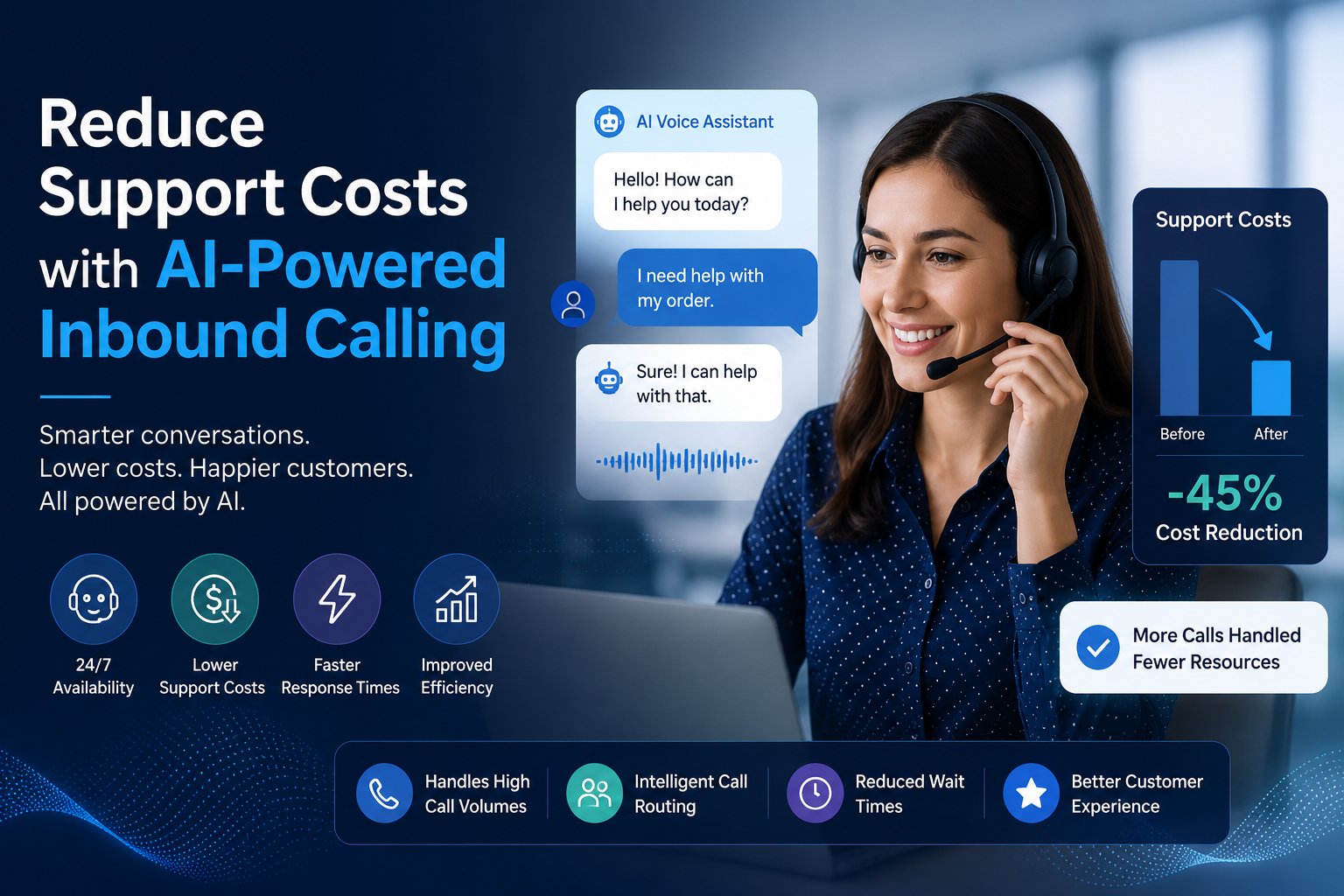
Customer support costs are rising faster than most businesses expect. Growing call volumes, longer wait times, repetitive customer queries, and staffing limitations are making traditional support operations increasingly expensive to maintain.
At the same time, customers expect immediate responses. They do not want to wait in long queues or repeat the same issue multiple times before getting help. Consequently, businesses are under pressure to improve service quality while controlling operational expenses.
This is where AI inbound calling is changing the landscape.
Modern AI-powered inbound systems can answer calls instantly, automate repetitive conversations, route customers intelligently, and assist support teams in handling higher volumes without increasing headcount.
Moreover, businesses are now using AI voice automation not just to reduce costs, but also to improve customer experience at scale.
Moreover, businesses are now using AI voice automation not just to reduce costs, but also to improve customer experience at scale.
For organizations looking to modernize support operations, AI-driven communication is becoming a practical competitive advantage rather than an experimental technology.
Why Traditional Support Teams Struggle to Scale Efficiently
Most customer support teams face a similar challenge: support demand grows faster than operational capacity.
As businesses expand, inbound calls increase across sales inquiries, appointment requests, billing concerns, onboarding questions, and general customer assistance. However, scaling a human-only support model quickly becomes expensive.
Several hidden operational costs often impact support performance:
- High hiring and training expenses
- Increased agent burnout
- Long response queues during peak hours
- Inconsistent customer experiences
- Missed calls outside business hours
- Low productivity from repetitive conversations
Additionally, support teams frequently spend valuable time answering simple repetitive questions that could easily be automated.
This creates inefficiencies that affect both customer satisfaction and profitability.
How AI Inbound Calling Reduces Support Costs Without Sacrificing Experience
Unlike traditional IVR systems that frustrate callers with rigid menus, modern AI inbound calling platforms can understand natural conversations and respond intelligently in real time.
Instead of replacing support teams entirely, AI helps businesses reduce operational pressure while improving responsiveness.
AI-powered inbound systems can:
- Answer calls instantly 24/7
- Handle repetitive support queries automatically
- Route customers to the correct department
- Capture lead and customer information
- Schedule appointments
- Provide multilingual assistance
- Reduce missed opportunities from unanswered calls
As a result, businesses can significantly reduce dependency on large frontline support teams for routine interactions.
Meanwhile, human agents can focus on high-value or complex customer conversations that require empathy and decision-making.
Companies implementing intelligent voice automation are increasingly combining it with broader AI-powered customer engagement strategies to create faster and more connected communication experiences across departments.
AI Inbound Calling Improves Response Times Across Customer Touchpoints
AI Inbound Calling Improves Response Times Across Customer Touchpoints
One of the biggest drivers of support costs is delayed response handling.
When customers wait too long:
- escalation rates increase
- customer frustration rises
- Churn becomes more likely
- support tickets multiply unnecessarily
AI-powered inbound systems help solve this by reducing response bottlenecks immediately.
For example, businesses using intelligent voice automation can:
- Respond to every inbound call instantly
- Eliminate hold-time overload
- Automate first-level support interactions
- Route urgent calls faster
- Prioritize customer intent intelligently
Furthermore, faster response times directly impact customer trust and retention.
Furthermore, faster response times directly impact customer trust and retention.
According to Gartner, customer experience continues to be a major competitive differentiator for businesses adopting AI-driven support models.
Similarly, research from McKinsey & Company highlights how automation improves operational efficiency while helping organizations scale service delivery more effectively.
Businesses integrating AI voice systems with omnichannel communication tools also create more seamless customer journeys across calls, chat, email, and messaging platforms.
Reducing Missed Calls Can Directly Improve Revenue Retention
Many businesses underestimate how much revenue is lost through unanswered inbound calls.
A missed support or sales inquiry often means:
- a lost lead
- a delayed conversion
- reduced customer trust
- negative service perception
This becomes even more critical outside working hours.
AI inbound calling systems help businesses maintain continuous availability without requiring large overnight teams. Consequently, customers receive immediate engagement regardless of business hours.
This is especially valuable for industries such as:
- healthcare
- real estate
- SaaS
- logistics
- financial services
- service-based businesses
Additionally, AI systems can collect caller intent, summarize interactions, and transfer complete context to human agents when escalation is needed.
This reduces friction while improving operational continuity.
Businesses adopting solutions like an AI receptionist platform are increasingly using automation to ensure no high-intent customer conversation goes unanswered.
Intelligent Call Routing Creates More Efficient Support Operations
Support inefficiency is not always caused by staffing shortages. Often, the problem comes from poor call distribution.
Customers are frequently transferred multiple times before reaching the correct department. This increases frustration and extends average handling times.
AI-powered inbound calling improves this process through intelligent routing.
Using conversational intent analysis, AI systems can:
- Identify customer needs instantly
- Prioritize urgent requests
- Direct calls to specialized teams
- Reduce unnecessary transfers
- Improve first-call resolution rates
Therefore, support teams operate more efficiently while customers experience faster assistance
.
.
Organizations scaling support operations are also integrating inbound lead management systems to unify customer communication and improve operational visibility.
According to IBM, AI-driven customer service workflows are helping businesses optimize support operations while improving user satisfaction.
AI Inbound Calling Supports Scalable Business Growth
Support operations that rely entirely on manual processes often struggle during rapid growth phases.
Seasonal spikes, marketing campaigns, and expanding customer bases can quickly overwhelm internal teams.
However, AI inbound systems provide scalability without proportional increases in operational cost.
Businesses can:
- Handle larger call volumes
- Automate repetitive workflows
- Expand support coverage
- Maintain consistency across interactions
- Improve reporting and analytics
Moreover, AI-generated call insights can help leadership teams identify recurring customer concerns, operational gaps, and service bottlenecks faster.
Organizations combining voice automation with custom AI automation solutions are building more scalable customer support ecosystems that adapt as business needs evolve.
According to Microsoft AI, scalable AI adoption is becoming essential for businesses looking to modernize customer engagement strategies efficiently.
The Future of Customer Support Is AI-Assisted, Not Human-Replaced
There is a common misconception that AI eliminates human support and teams. In reality, the most effective businesses use AI to strengthen human performance rather than replace it.
AI handles repetitive, time-sensitive, and high-volume interactions. Meanwhile, human agents focus on strategic conversations requiring empathy, negotiation, and critical thinking.
This creates a more balanced support model where:
- Customers receive faster responses
- Support teams avoid burnout
- operational costs become manageable
- businesses scale more efficiently
Furthermore, AI-powered inbound communication allows organizations to maintain consistency across customer experiences while improving operational agility.
Businesses investing early in intelligent automation will likely gain long-term advantages in both customer retention and operational efficiency.
Conclusion
Rising support costs are forcing businesses to rethink how customer communication is managed.
Traditional support models alone are no longer sustainable for organizations handling growing inbound demand.
Traditional support models alone are no longer sustainable for organizations handling growing inbound demand.
AI inbound calling offers a practical solution by automating repetitive interactions, reducing missed calls, improving response times, and helping teams scale more efficiently.
More importantly, it allows businesses to deliver faster and more reliable customer experiences without continuously increasing operational expenses.
As customer expectations continue to evolve, companies adopting AI-powered communication systems will be better positioned to improve support performance while maintaining long-term scalability.