Agentic AI vs AI Agents: Understanding the Difference and Choosing the Right Approach
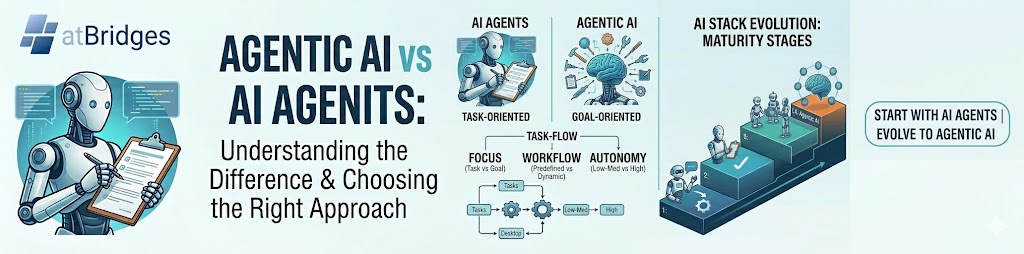
Artificial Intelligence is evolving rapidly, and terms like AI Agents and Agentic AI are often used interchangeably. While they are related, they represent different levels of autonomy, complexity, and business value.
Understanding when to use AI Agents versus Agentic AI can help organizations build more effective AI solutions while avoiding unnecessary complexity and cost.
What Are AI Agents?
An AI Agent is a software system that performs a specific task on behalf of a user. It typically follows predefined instructions, uses tools when needed, and operates within a limited scope.
Examples include:
- Customer support chatbots
- Appointment scheduling assistants
- Insurance verification assistants
- Email drafting assistants
- FAQ and knowledge-base bots
AI agents are designed to solve a particular problem efficiently and predictably.
Characteristics of AI Agents
- Task-oriented
- Operate within defined workflows
- Limited decision-making capability
- Usually use a small number of tools
- Easier to monitor and control
- Lower implementation cost
Example
A clinic appointment assistant:
- Collects patient information
- Checks insurance eligibility
- Finds available appointment slots
- Books the appointment
The agent follows a structured workflow and only makes decisions within predefined boundaries.
What Is Agentic AI?
Agentic AI refers to AI systems capable of independently planning, reasoning, adapting, and executing multi-step objectives with minimal human intervention.
Instead of simply following a workflow, Agentic AI can determine:
- What actions need to be taken
- Which tools to use
- In what order tasks should be executed
- How to recover from failures
- When additional information is required
The system focuses on achieving a goal rather than following a fixed process.
Characteristics of Agentic AI
- Goal-oriented
- Dynamic planning
- Autonomous decision making
- Multi-step reasoning
- Tool orchestration
- Adaptive execution
- Self-correction capabilities
Example
A healthcare operations assistant:
Goal: Reduce patient no-show rates.
The system may:
- Analyze historical appointment data
- Identify high-risk patients
- Send personalized reminders
- Reschedule conflicting appointments
- Notify staff about potential issues
- Track outcomes and improve future actions
No fixed workflow dictates every step. The AI decides what actions best achieve the goal.
AI Agent vs Agentic AI
| Feature | AI Agent | Agentic AI |
|---|---|---|
| Focus | Task Completion | Goal Achievement |
| Workflow | Predefined | Dynamic |
| Autonomy | Low to Medium | High |
| Planning | Limited | Advanced |
| Decision Making | Rule-Based | Context-Based |
| Tool Usage | Fixed | Adaptive |
| Complexity | Lower | Higher |
| Risk Level | Lower | Higher |
| Cost | Lower | Higher |
AI Stack Evolution
Organizations typically progress through several stages of AI maturity.
Level 1: Prompt-Based AI
User asks a question and receives a response.
Examples
- ChatGPT
- Internal knowledge assistants
-
FAQ bots
Best For
- Content generation
- Q&A systems
- Knowledge retrieval
Level 2: AI Agents
AI gains access to tools and workflows.
Examples
- Appointment booking systems
- Customer support automation
- CRM update assistants
Best For
- Repetitive business processes
- Structured workflows
- Process automation
Level 3: Multi-Agent Systems
Multiple specialized agents collaborate.
Examples
- Research Agent
- Coding Agent
- Testing Agent
- Reporting Agent
Working together toward a shared objective.
Best For
- Complex business operations
- Large-scale automation
- Cross-functional workflows
Level 4: Agentic AI
AI plans, reasons, adapts, and executes autonomously.
Examples
- Autonomous business operators
- AI project managers
- AI operations coordinators
- Strategic planning systems
Best For
- Open-ended objectives
- Dynamic environments
- Continuous optimization
When to Use AI Agents
Choose AI Agents when:
The Process Is Well Defined
If the workflow is known and predictable, an agent is usually sufficient.
Examples:
- Appointment scheduling
- Insurance verification
- Order tracking
- Lead qualification
Compliance Is Important
Industries like healthcare, finance, and insurance often require predictable behavior and auditability.
Reliability Matters More Than Flexibility
For operational tasks, consistency often outweighs autonomy.
Budget and Timeline Are Limited
AI agents are significantly faster and cheaper to build.
When to Use Agentic AI
Choose Agentic AI when:
Goals Are More Important Than Processes
The AI needs freedom to determine how objectives should be achieved.
The Environment Changes Frequently
Examples:
- Supply chain optimization
- Market research
- Cybersecurity monitoring
- Strategic business planning
Multiple Systems Must Be Coordinated
Agentic AI excels at orchestrating:
- Databases
- APIs
- CRM systems
- ERP platforms
- Communication tools
Human Intervention Must Be Minimized
The AI can independently adapt and recover from changing conditions.
Common Mistake: Building Agentic AI Too Early
Many teams jump directly to Agentic AI because it sounds more advanced.
This often creates:
- ->Increased costs
- ->Unpredictable behavior
- ->Longer development cycles
- ->More testing requirements
- ->Greater operational risk
A useful guideline is:
If a flowchart can describe your process, start with an AI Agent.
Most business automation projects fall into this category.
Only consider Agentic AI when workflows become too dynamic to define in advance.
Real-World Example: Healthcare Appointment Booking
AI Agent Approach
Workflow:
- Collect patient information
- Verify insurance
- Check appointment availability
- Book appointment
This approach is:
- Fast
- Reliable
- Easy to audit
- HIPAA-friendly
Agentic AI Approach
Goal:
"Maximize appointment utilization while minimizing patient wait times."
The system might:
- Analyze cancellations
- Predict no-shows
- Rearrange schedules
- Offer alternative slots
- Contact waiting-list patients
This requires planning and autonomous decision-making, making Agentic AI a better fit.
Decision Framework
Ask these questions:
Use AI Agents if:
✅ The workflow is known
✅ Compliance is critical
✅ Predictability matters
✅ Limited autonomy is acceptable
✅ Faster deployment is needed
Use Agentic AI if:
✅ Objectives are open-ended
✅ Multiple tools must be coordinated
✅ Dynamic planning is required
✅ Continuous optimization is desired
✅ Human oversight can be limited
Final Thoughts
AI Agents and Agentic AI are not competitors—they are different stages of AI capability.
For most organizations today, AI Agents deliver the highest return on investment because business processes are usually structured and well-defined.
Agentic AI becomes valuable when the problem shifts from "follow this process" to "achieve this objective."
A practical strategy is:
- Start with AI Agents.
- Measure outcomes.
- Introduce multi-agent orchestration where needed.
- Evolve into Agentic AI only when autonomy provides clear business value.
The most successful AI implementations are not the most autonomous—they are the ones that solve the business problem with the right level of intelligence.