The Evolution of Artificial Intelligence: A Decade of Transformation (2016–2026)
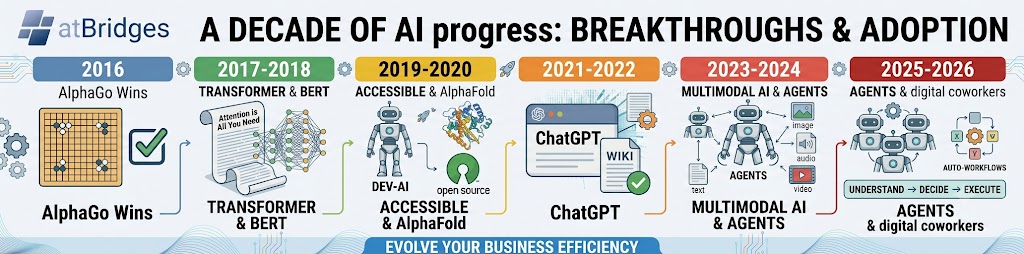
Over the past ten years, Artificial Intelligence (AI) has evolved from a promising research field into one of the most transformative technologies of the modern era. Between 2016 and 2026, AI fundamentally changed how businesses operate, how people interact with technology, and how industries solve complex problems.
2016: AI Proved It Could Solve Complex Problems
DeepMind's AlphaGo defeated world Go champion Lee Sedol, demonstrating the power of reinforcement learning and deep neural networks.
-> Reinforcement Learning
-> Deep Neural Networks
-> Massive industry investment
-> Reinforcement Learning
-> Deep Neural Networks
-> Massive industry investment
2017: The Transformer Revolution
The paper Attention Is All You Need introduced the Transformer architecture, which became the foundation of modern Large Language Models.
2018: AI Learned to Understand Context
Google introduced BERT, dramatically improving contextual language understanding for search, chatbots, and document analysis.
2019: AI Became Accessible
GPT-2 and Hugging Face accelerated open-source AI development and made pretrained models widely available.
2020: Foundation Models
GPT-3 demonstrated few-shot learning while AlphaFold 2 transformed protein structure prediction and scientific research.
2021: Enterprise AI
Organizations adopted AI APIs, Retrieval-Augmented Generation (RAG), and fine-tuning to build production-ready applications.
2022: Generative AI Explosion
ChatGPT, Stable Diffusion, DALL·E 2, and Whisper brought conversational AI, image generation, and speech recognition to millions.
2023: AI Entered Everyday Work
GPT-4, Claude, Gemini, Llama 2, and Mistral improved reasoning, coding, and enterprise automation.
2024: Multimodal AI
AI began understanding text, images, audio, video, and documents while AI agents gained the ability to use tools and automate workflows.
2025: The Age of AI Agents
AI agents evolved beyond chatbots to plan, reason, use memory, and execute complex business workflows autonomously.
2026: AI in Production
AI became a core part of business operations, powering customer support, healthcare, legal services, finance, software development, and research.
A Decade of Progress
| Year | Breakthrough | Impact |
|---|---|---|
| 2016 | AlphaGo | Reinforcement Learning |
| 2017 | Transformer | Foundation of LLMs |
| 2018 | BERT | Context-aware NLP |
| 2019 | GPT-2 | Open AI ecosystem |
| 2020 | GPT-3 & AlphaFold | Foundation models |
| 2021 | Enterprise AI | Business adoption |
| 2022 | ChatGPT | Generative AI |
| 2023 | GPT-4 | Reasoning & coding |
| 2024 | Multimodal AI | Unified AI experiences |
| 2025 | AI Agents | Autonomous workflows |
| 2026 | Production AI | Enterprise transformation |
Conclusion
The journey from 2016 to 2026 transformed AI from a specialized research discipline into a foundational technology used across nearly every industry. The next decade is expected to bring even more capable, autonomous, and collaborative AI systems.