AI-Powered Cold Calling: Does It Really Work?
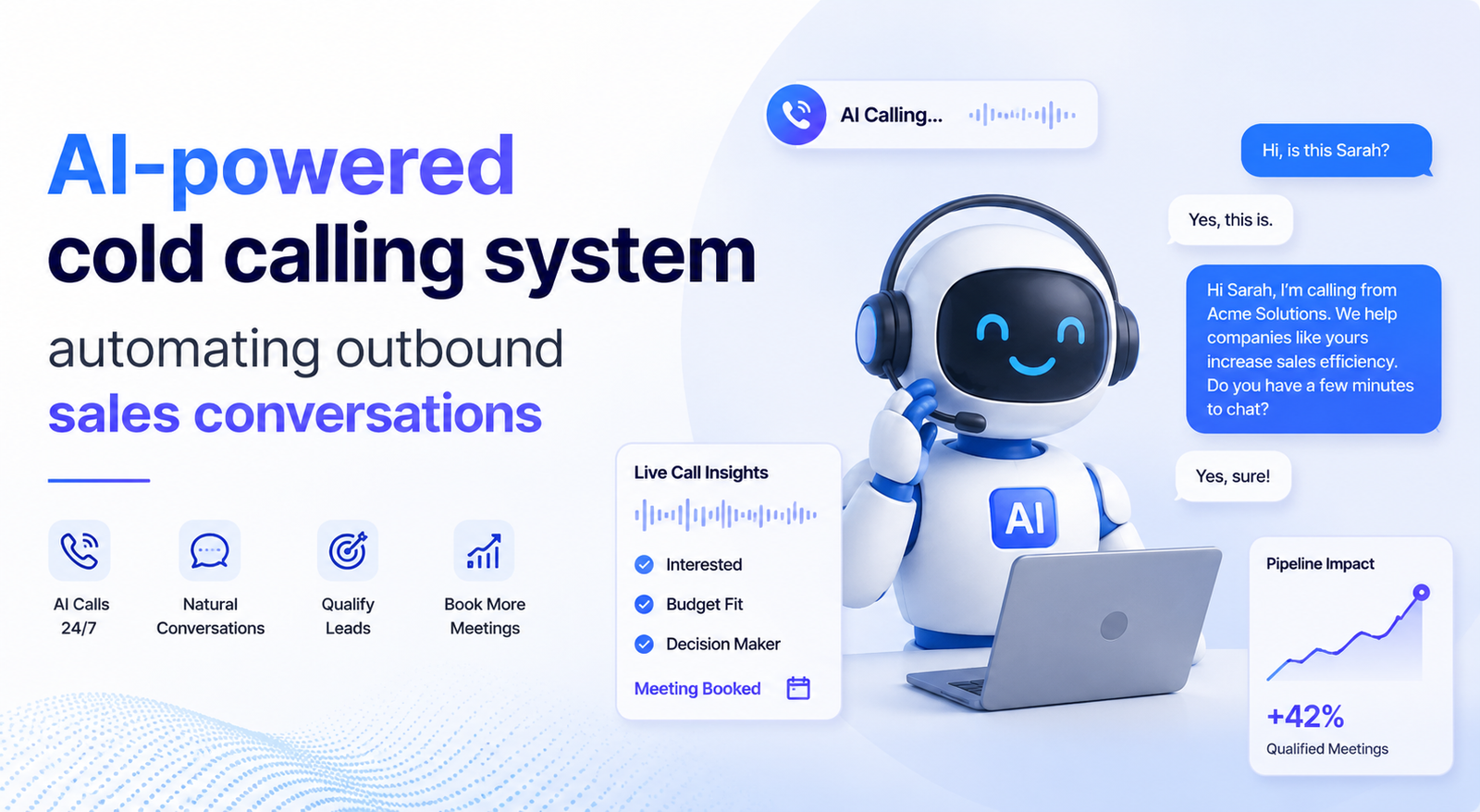
Cold calling has always been one of the most challenging parts of sales. It demands consistency, speed, personalization, and continuous follow-up — all while sales teams try to manage growing lead volumes and aggressive targets.
However, traditional outbound calling strategies are becoming harder to scale. Sales representatives spend hours dialing numbers, qualifying unresponsive leads, leaving voicemails, and repeating the same introductory conversations daily. As a result, productivity drops while customer acquisition costs continue to rise.
This is why businesses are now exploring AI cold calling as a smarter alternative.
Modern AI-powered outbound calling systems can automate repetitive outreach tasks, qualify prospects in real time, route interested leads to sales teams, and maintain consistent communication at scale. Moreover, AI-driven calling platforms are helping businesses increase outreach efficiency without dramatically expanding sales headcount.
The question many companies are asking now is simple: does AI-powered cold calling actually work in real-world sales environments?
The answer depends on how businesses use it — and increasingly, the results suggest that intelligent automation is transforming outbound sales operations faster than expected.
Why Traditional Cold Calling Is Becoming Less Efficient
Sales teams today operate in a far more competitive environment than they did a decade ago.
Prospects receive constant outreach through calls, emails, social media, and messaging platforms. Consequently, capturing attention has become increasingly difficult.
Traditional cold calling often struggles because:
- agents spend too much time on manual dialing
- repetitive conversations reduce productivity
- lead qualification consumes valuable sales hours
- inconsistent follow-ups impact conversion rates
- scaling outbound teams becomes expensive
Additionally, many businesses face operational inefficiencies caused by disconnected communication systems and poor lead prioritization.
This creates a major challenge: sales teams spend significant effort reaching low-intent prospects while high-quality opportunities may receive delayed responses.
AI cold calling aims to solve this by automating the early stages of outreach while improving lead handling efficiency.
Suggested Image Idea
Sales team dashboard comparing manual cold calling versus AI-driven outbound automation.
ALT Text: “AI cold calling improving outbound sales efficiency”
How AI Cold Calling Automates High-Volume Outreach
AI-powered outbound calling platforms are designed to handle repetitive sales interactions intelligently.
Instead of requiring agents to manually manage every call, AI systems can initiate conversations, analyze responses, qualify prospects, and escalate interested leads automatically.
Modern AI calling systems can:
- place outbound calls at scale
- identify customer intent
- answer common questions
- qualify prospects based on predefined criteria
- schedule appointments automatically
- route hot leads to human sales agents
- maintain follow-up consistency
As a result, sales teams spend less time on repetitive prospecting tasks and more time closing qualified opportunities.
Moreover, businesses implementing outbound sales automation are increasingly combining AI voice systems with CRM workflows and analytics tools to improve pipeline visibility and lead tracking.
According to Salesforce AI, automation is becoming critical for organizations looking to scale customer engagement while maintaining operational efficiency.
Suggested Image Idea
AI voice assistant making automated outbound calls with CRM integration.
ALT Text: “AI cold calling platform automating outbound lead outreach”
AI Cold Calling Improves Lead Qualification Speed
One of the biggest inefficiencies in outbound sales is the time spent qualifying unresponsive or low-intent leads.
Sales representatives often spend hours identifying whether prospects are genuinely interested before meaningful conversations even begin.
AI cold calling systems help streamline this process through conversational intelligence.
Using natural language processing and predefined workflows, AI can:
- ask qualification questions
- capture prospect responses
- identify buying intent
- segment leads automatically
- prioritize high-conversion opportunities
Consequently, businesses can reduce wasted outreach effort while improving sales productivity.
Furthermore, faster qualification allows human sales teams to focus on decision-makers who are already interested in moving forward.
Organizations integrating AI with AI-powered customer engagement systems are seeing improvements in both lead response times and sales workflow efficiency.
Research from McKinsey & Company highlights how AI-driven automation can significantly improve sales productivity and operational performance.
Suggested Image Idea
Lead qualification dashboard powered by conversational AI analytics.
ALT Text: “AI cold calling software qualifying sales leads automatically”
Does AI Cold Calling Actually Sound Human?
One of the most common concerns businesses have is whether AI-generated conversations feel robotic or unnatural.
Earlier automated systems often relied on rigid scripts and predictable IVR-style responses. However, modern conversational AI has evolved significantly.
Today’s AI voice platforms can:
- understand natural speech patterns
- respond contextually
- personalize conversations dynamically
- adjust tone and pacing
- detect customer intent more accurately
As a result, many AI-assisted outbound conversations now feel far more natural than traditional automation systems.
That said, AI cold calling performs best when used strategically.
Businesses seeing the strongest results are not replacing sales teams entirely. Instead, they use AI to:
- automate repetitive first-touch outreach
- handle lead qualification
- reduce manual dialing workload
- improve speed-to-contact
Meanwhile, human sales representatives focus on relationship-building and closing conversations.
Companies adopting AI agent solutions are increasingly using AI as a sales acceleration layer rather than a full replacement for human interaction.
Suggested Image Idea
AI voice assistant interacting naturally with a sales prospect.
ALT Text: “AI cold calling assistant handling human-like sales conversations”
AI Cold Calling Helps Businesses Scale Outreach Faster
Scaling outbound sales traditionally requires hiring more representatives, increasing operational costs, and expanding management overhead.
However, AI-powered calling systems allow businesses to scale outreach without proportional increases in staffing.
This becomes especially valuable for:
- SaaS companies
- real estate businesses
- B2B service providers
- recruitment agencies
- financial service firms
- healthcare appointment teams
AI systems can manage large outbound campaigns simultaneously while maintaining consistency across customer interactions.
Additionally, businesses gain access to detailed call analytics, conversion tracking, and conversation insights that help optimize sales strategies over time.
Organizations integrating AI with omnichannel communication tools are also creating more connected customer engagement experiences across calls, email, SMS, and digital channels.
According to IBM AI Solutions, businesses using AI automation are improving both operational scalability and customer engagement efficiency.
Suggested Image Idea
Outbound sales campaign dashboard powered by AI automation.
ALT Text: “AI cold calling system scaling outbound sales operations”
The Real Limitation of AI Cold Calling
While AI outbound calling offers significant advantages, it is not a perfect replacement for strategic sales conversations.
Complex negotiations, emotional decision-making, enterprise relationship building, and high-ticket sales still require human expertise.
Therefore, the most effective approach is usually hybrid automation.
AI handles:
- repetitive outreach
- lead qualification
- appointment booking
- initial engagement
Human teams handle:
- relationship development
- negotiation
- closing discussions
- strategic account management
This creates a more efficient outbound sales ecosystem where businesses reduce operational waste while improving sales responsiveness.
Furthermore, businesses combining AI outreach with custom AI automation solutions are building scalable sales infrastructures that adapt more effectively to growing lead volumes.
Suggested Image Idea
Hybrid sales workflow combining AI automation and human sales representatives.
ALT Text: “AI cold calling supporting hybrid outbound sales teams”
Conclusion
AI cold calling is no longer just an experimental sales technology. Businesses across industries are now using intelligent outbound automation to improve outreach efficiency, qualify leads faster, and reduce repetitive sales workloads.
More importantly, AI-powered calling systems allow organizations to scale outbound communication without continuously increasing operational costs.
However, the most successful companies are not removing human sales teams entirely. Instead, they are using AI strategically to enhance speed, consistency, and lead handling efficiency while allowing human representatives to focus on high-value conversations.
As outbound sales environments become more competitive, businesses adopting AI cold calling early will likely gain stronger operational advantages in both scalability and customer engagement.