LiveKit vs AWS Nova Sonic STS: A Technical Comparison for Building Real Time Voice AI Agents
Introduction
Real-time voice AI has become a critical technology for businesses building AI receptionists, customer support assistants, healthcare agents, and sales automation systems. Users expect conversations to feel natural, with minimal delays, clear audio, and the ability to interrupt the assistant just as they would during a conversation with another person.
Among today's most popular approaches are LiveKit Agents and AWS Nova Sonic STS. While both enable developers to build production-ready voice agents, they follow fundamentally different architectural philosophies. Rather than determining which is "better," it's more valuable to understand how they compare across key technical areas such as latency, conversation flow, infrastructure, scalability, and deployment.
What is LiveKit?
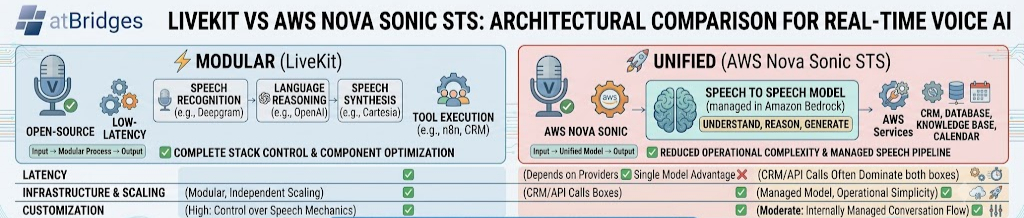
LiveKit is an open-source real-time communication platform designed for low-latency audio and video streaming. Its Agent Framework allows developers to build voice AI by integrating independent components such as speech recognition, language models, text-to-speech engines, and external business tools.
Because every component is modular, developers can choose providers that best match their performance, pricing, or quality requirements. For example, one application may use Deepgram for speech recognition, OpenAI for reasoning, Cartesia for speech synthesis, and an n8n workflow for tool execution.
This flexibility makes LiveKit a popular choice for teams that want complete control over their AI stack.
What is AWS Nova Sonic STS?
AWS Nova Sonic STS is Amazon's speech-to-speech foundation model available through Amazon Bedrock. Unlike modular architectures, Nova Sonic combines speech understanding, language reasoning, and speech generation within a single AI model.
Instead of connecting multiple AI providers together, developers primarily focus on integrating business systems such as appointment schedulers, CRMs, databases, or knowledge bases. The speech processing itself remains unified, reducing the need to orchestrate multiple speech services.
This approach simplifies development while allowing applications to leverage the broader AWS ecosystem.
Architecture Comparison
The biggest difference between these two approaches lies in how speech processing is handled.
With LiveKit, developers assemble individual services into a complete conversational pipeline. Every stage from speech recognition to language processing and speech synthesis can be independently selected, configured, or replaced as requirements evolve.
AWS Nova Sonic STS follows a unified architecture where speech understanding and speech generation are handled by the same foundation model. Developers still integrate external APIs and business tools, but the speech pipeline itself requires significantly less orchestration.
This architectural distinction influences many other aspects of production deployments.
Latency
Latency is one of the most important performance indicators for any voice AI system. Users expect responses within a fraction of a second, and even small delays can make conversations feel unnatural.
LiveKit's overall latency depends on the combined performance of the selected speech recognition provider, language model, text-to-speech engine, network conditions, and backend services. Because multiple independent services communicate during every interaction, response times can vary depending on the chosen providers and deployment architecture.
Nova Sonic STS reduces inter-service communication by performing speech understanding and speech generation within a single managed model. This can reduce the orchestration overhead associated with coordinating multiple AI providers. However, overall response time still depends on application logic, external API calls, and backend processing.
For both architectures, slow database queries, CRM lookups, calendar availability checks, or third-party APIs often contribute more to perceived latency than the AI model itself.
Conversation Flow and User Experience
Natural conversation extends beyond speech recognition accuracy. Users expect voice assistants to respond smoothly, detect pauses correctly, and support interruptions without creating awkward delays.
LiveKit provides developers with extensive control over conversational behavior. Parameters such as voice activity detection, endpointing, buffering, interruption handling, and streaming behavior can all be customized to suit different applications.
Nova Sonic STS manages much of this conversational behavior internally. Developers spend less time configuring speech mechanics and more time focusing on prompts, business workflows, and application logic.
Both approaches support real-time streaming conversations, but they differ in how much control developers have over the underlying speech pipeline.
Infrastructure and Scalability
Infrastructure requirements differ significantly between the two approaches.
A LiveKit deployment typically includes the LiveKit server, one or more AI providers for speech recognition and speech synthesis, a language model, agent runtime, monitoring systems, and backend services. While this architecture introduces additional operational components, it also enables independent scaling and replacement of individual services.
AWS Nova Sonic STS simplifies the AI infrastructure by consolidating speech processing within Amazon Bedrock. Developers primarily manage their application servers, databases, monitoring, and business integrations while relying on AWS to handle the underlying speech model infrastructure.
Organizations already operating within AWS may find this approach aligns naturally with their existing cloud architecture.
Deployment Considerations
Deployment strategies often depend on an organization's technical priorities.
Teams requiring complete control over every component of the conversational pipeline may prefer a modular architecture that allows independent provider selection and optimization. This flexibility supports experimentation with new speech models or specialized AI services without redesigning the entire application.
On the other hand, organizations seeking a more streamlined deployment may benefit from a unified speech model that reduces operational complexity and minimizes the number of AI services requiring maintenance.
Regardless of architecture, production deployments should include comprehensive logging, monitoring, retry mechanisms, rate limiting, and performance metrics to ensure reliable operation at scale.
Conclusion
LiveKit Agents and AWS Nova Sonic STS represent two different approaches to building modern voice AI systems.
LiveKit emphasizes flexibility, allowing developers to assemble and optimize every stage of the conversational pipeline using independent providers. AWS Nova Sonic STS focuses on simplifying speech processing by integrating speech understanding and speech generation into a single managed model while leaving business logic and external integrations under the developer's control.
When evaluating either architecture, technical teams should compare practical factors such as latency, conversation flow, infrastructure complexity, scalability, operational requirements, and integration strategy. These considerations provide a far more meaningful evaluation than asking which platform is universally "best," since the ideal architecture depends on the specific requirements of each production voice AI application.