From Generative AI to Production AI: How the Industry Changed in Five Years
Introduction
Generative AI has experienced one of the fastest transformations in modern technology. In just five years, it has moved from an emerging research area into a core technology being explored and deployed across almost every industry.
What makes this evolution interesting is that the technology didn't simply become better at generating text and images. The entire way developers build AI applications has changed.
The industry has moved from experimenting with language models to building AI-powered systems capable of understanding business context, accessing information, interacting with software, and completing complex tasks.Understanding this journey helps explain where AI engineering is heading next.
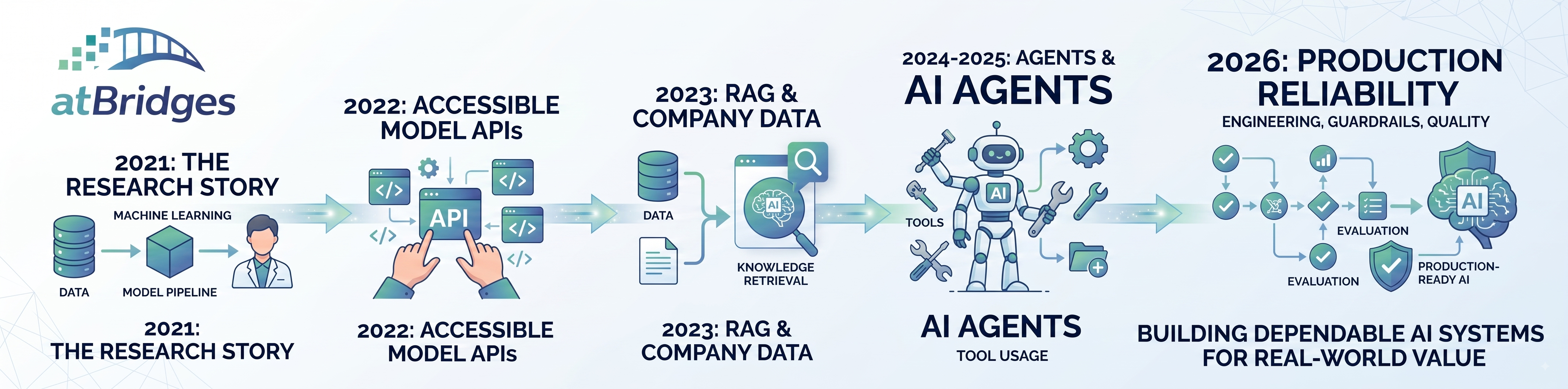
2021: When Large Language Models Were Still Mostly a Research Story
In 2021, large language models were gaining attention among researchers and technology companies, but they had not yet become mainstream development tools.
AI development was still heavily associated with traditional machine learning pipelines. Teams worked with datasets, trained specialized models, and built systems for specific tasks such as classification, recommendation, forecasting, and language processing.
Natural language models were improving rapidly, but using them in everyday business applications wasn't yet straightforward.
For many developers, AI still felt like something built by specialized machine learning teams rather than a capability available to almost every software engineer.
That was about to change.
2022: Generative AI Reaches Developers
The rise of conversational AI dramatically changed public and developer awareness of large language models.
People discovered that a machine could generate useful content, explain technical concepts, summarize information, write code, and interact naturally through conversation.
For developers, the bigger opportunity was accessibility.
Instead of training a large model themselves, teams could integrate powerful models through APIs and build applications around them.
This created a new generation of products, including AI writing tools, coding assistants, content platforms, research assistants, and conversational applications.
The model became a service that developers could build on rather than something every company needed to train independently.
2023: Company Data Becomes Part of the AI Experience
As organizations started experimenting with generative AI, an obvious limitation appeared.
General-purpose models could be impressive, but they didn't automatically have access to a company's latest documents, internal knowledge, databases, or operational information.
This created enormous interest in Retrieval-Augmented Generation, commonly known as RAG.
RAG allowed applications to retrieve relevant information from external sources before generating a response.
This was a major step forward because companies could build AI applications around their own knowledge without relying entirely on model training. Embeddings, vector databases, semantic search, document processing, and retrieval pipelines consequently became important parts of AI application development.Generative AI was becoming more useful for real business scenarios.
2024: AI Starts Moving Beyond Conversation
The next major shift came when developers started asking a different question.
What if AI could do something instead of simply telling us how to do it?
Modern AI applications increasingly gained access to tools and external systems. An AI system could search information, interact with APIs, query databases, analyze files, perform calculations, or initiate business workflows.
This introduced a more action-oriented approach to AI.The model was no longer only responsible for generating a response. It could help determine which capability was needed and use that capability to complete a task.This development accelerated interest in AI agents and agentic workflows.
2025: AI Agents Become a Major Engineering Focus
AI agents became one of the biggest areas of experimentation and development.
An agent could maintain context, decide what information it needed, use available tools, evaluate results, and continue working toward an objective.
More advanced systems also began combining specialized agents for different responsibilities.
However, building an agent was only the beginning.Organizations quickly discovered that an agent that works perfectly in a demonstration may behave unpredictably in production.
This brought attention to memory management, tool permissions, workflow design, evaluation, monitoring, security, and cost control.AI engineering was becoming much broader than prompt writing.
2026: Reliability Becomes the Real Competitive Advantage
Today, the biggest challenge is no longer proving that AI can perform impressive tasks.
The challenge is making it dependable.
Businesses need AI systems that can operate consistently, protect sensitive information, respond within acceptable latency, control costs, and recover when something goes wrong.
This has created greater demand for AI evaluation, observability, guardrails, structured outputs, security controls, human oversight, and production monitoring.Teams are also paying much more attention to context engineering.
Providing a model with more information doesn't necessarily produce better results. The information needs to be relevant, correctly structured, and available at the right moment.
The same principle applies to tools and memory. Giving an agent unlimited access can create unnecessary complexity and security risks.The goal is not maximum autonomy.The goal is useful and controlled autonomy.
How AI Engineering Has Changed
The biggest transformation over these five years is the role of the AI engineer.
Earlier, the focus was often on making a model generate a useful response.
Today, engineers have to think about the entire system surrounding the model.
That includes data pipelines, retrieval, APIs, tools, application logic, security, evaluation, monitoring, infrastructure, user experience, and business requirements.
A successful AI product therefore depends on much more than choosing a powerful model.
The surrounding engineering determines whether the system can actually deliver value.
What Businesses Should Focus On Next
Organizations entering the next phase of AI adoption should avoid building their strategy around a single model or framework.Models will improve. APIs will change. Frameworks will be replaced. New architectures will emerge.
The fundamentals will remain more important.Businesses should focus on identifying valuable use cases, maintaining high-quality data, designing reliable workflows, measuring AI performance, protecting information, and continuously improving systems based on real-world results.The companies that succeed with AI won't necessarily be those that experiment with every new technology.They will be the ones that connect AI capabilities to measurable business outcomes.
Conclusion
The evolution of generative AI over the past five years has been remarkable.
It started with powerful language models becoming accessible to developers, expanded into applications connected to private organizational knowledge, progressed toward tool-using systems and agents, and is now entering a phase where reliability and production engineering matter more than novelty.
The next generation of AI won't simply be about generating better responses.
It will be about building intelligent systems that can operate safely, efficiently, and consistently in the real world.That is the real evolution of Generative AI and it is only getting started.