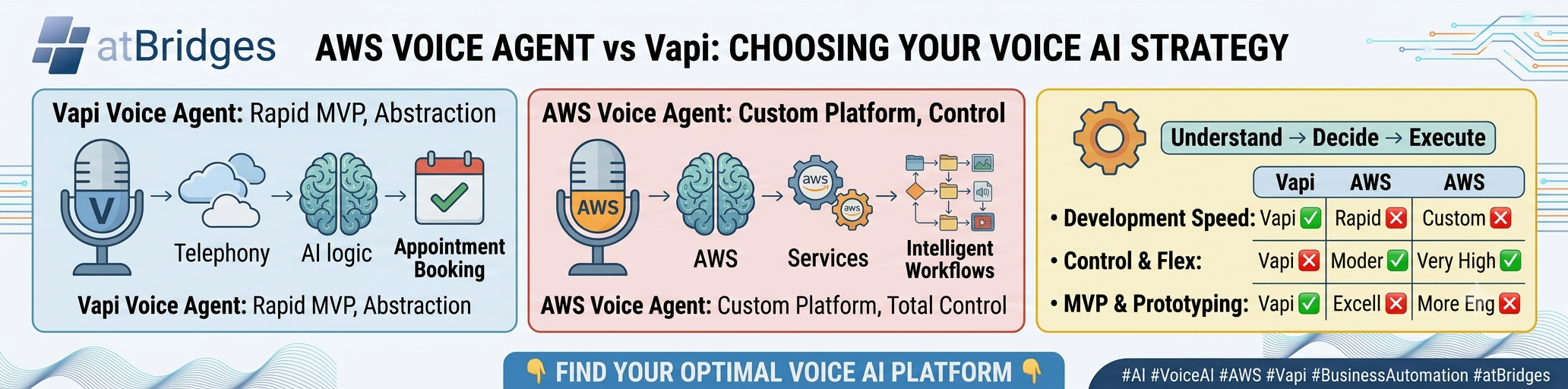
AWS Voice Agent vs Vapi: Which AI Voice Platform Is Better?
AI voice agents are changing how businesses handle customer service, appointment scheduling, sales, healthcare communication, and business automation. But when building a production-ready voice AI application, one important question remains: should you use a managed platform like Vapi or build a custom voice agent using AWS?
Both approaches can create powerful real-time voice agents. However, they differ significantly in development speed, infrastructure control, customization, scalability, and enterprise capabilities.
What Is a Vapi Voice Agent?
Vapi is a developer-focused platform for building voice AI applications. It simplifies connecting telephony, speech recognition, language models, text-to-speech, tools, and business APIs.
Developers can configure an assistant, define instructions, select voice and AI models, add tools, and connect a phone number without building the entire real-time audio infrastructure from scratch.
Vapi is especially useful for startups, MVPs, prototypes, and teams that want to launch an AI voice agent quickly.
What Is an AWS Voice Agent?
An AWS voice agent is a custom voice AI architecture built using AWS services and application infrastructure. Depending on the use case, developers can use Amazon Bedrock, Amazon Nova Sonic, WebSockets, FastAPI, telephony providers, agent frameworks, databases, and AWS monitoring services.
Amazon Nova Sonic enables real-time voice interactions through streaming-based speech conversations. This allows developers to build voice agents that can understand speech, respond naturally, and interact with external tools.
AWS provides significantly more control over the complete voice AI architecture, but it also requires more engineering work.
AWS vs Vapi: The Main Difference
The biggest difference between AWS and Vapi is the balance between abstraction and control.
Vapi abstracts much of the voice AI infrastructure, allowing developers to focus primarily on the assistant and business logic.
AWS gives developers more direct control over audio streaming, model sessions, tool execution, authentication, networking, logging, and infrastructure.
In simple terms, Vapi can help you launch faster, while AWS gives you more flexibility to build a customized long-term voice AI platform.
Development Speed
Vapi: Faster Development
Vapi is designed to reduce the engineering effort required to launch a voice agent. Developers can configure the assistant, connect tools, choose AI providers, and integrate phone numbers through the platform.
This makes Vapi a strong choice for companies that need to validate a product idea or launch an AI voice MVP quickly.
AWS: More Engineering, More Control
Building a custom AWS voice agent requires more development work. Teams may need to manage WebSocket connections, real-time audio streams, model sessions, tool-call events, error handling, authentication, and infrastructure scaling.
However, this additional engineering provides greater control over how the entire system operates.
Tool Calling and Business Automation
Modern voice agents must do more than answer questions. They need to perform real business actions.
- Check appointment availability
- Book or cancel appointments
- Update customer information
- Access a CRM
- Send notifications
- Transfer calls to human agents
Vapi provides tools and webhook integrations that allow an AI assistant to communicate with external applications and backend services.
With AWS, developers can build a custom tool execution layer. This provides more control over authentication, validation, retries, timeouts, permissions, and business logic.
For complex enterprise workflows, this level of control can be extremely valuable.
Telephony and Call Transfers
Both Vapi and AWS can be used to build telephone-based AI agents.
Vapi simplifies connecting voice assistants with telephony infrastructure, making it easier to build inbound and outbound calling systems.
With AWS, companies can build a custom architecture using providers such as Twilio and connect live audio streams to a custom voice agent backend.
A custom AWS implementation can provide more control over call routing, recording, session management, transfer logic, and custom business rules.
This is especially useful for healthcare, insurance, financial services, and customer support applications where calls may need to be transferred to specific departments or human specialists.
Scalability and Enterprise Control
Vapi reduces the amount of infrastructure that a development team needs to manage directly. This can make it easier to launch and operate a voice AI application.
AWS provides a broader infrastructure ecosystem for organizations that require more control over deployment, networking, security, monitoring, and scaling.
Organizations already using AWS may prefer building their voice AI systems within the same cloud environment to simplify infrastructure management and security policies.
Security and Compliance
Security is an important consideration when building voice AI applications, especially for healthcare, insurance, banking, and other regulated industries.
AWS provides extensive infrastructure controls, including identity management, encryption, networking controls, monitoring, and regional deployment options.
However, the security and compliance of a complete voice AI system depend on the configuration of all components, including telephony providers, databases, models, storage, and application infrastructure.
AWS Voice Agent vs Vapi Comparison
| Category | Vapi | AWS Voice Agent |
|---|---|---|
| Development speed | Very fast | Requires more engineering |
| Infrastructure control | Moderate | Very high |
| Customization | High | Very high |
| Tool calling | Built-in platform support | Fully customizable |
| Telephony setup | Easier | More engineering required |
| Enterprise infrastructure | Good | Excellent |
| MVP development | Excellent | More effort |
| Custom workflows | Good | Excellent |
When Should You Choose Vapi?
Vapi is a strong option when your priority is speed and simplicity.
- You need to launch a voice AI MVP quickly.
- You want to test a voice AI product idea.
- You have a small engineering team.
- You want simpler telephony integration.
- You need to connect external tools quickly.
When Should You Choose AWS?
AWS is a strong option when your priority is control and customization.
- You need complete control over the voice AI architecture.
- You are building an enterprise voice AI platform.
- You require custom security and networking.
- You need advanced session and call management.
- You require custom tool execution and business logic.
- You already use AWS as your primary cloud infrastructure.
Which Is Better: AWS Voice Agent or Vapi?
There is no universal winner. The right choice depends on your product, engineering resources, infrastructure requirements, and long-term goals.
Choose Vapi when you want to build and launch a voice AI application quickly with less infrastructure management.
Choose AWS when you need complete control over your voice agent architecture and want to build a scalable, customizable enterprise platform.
Many businesses may also benefit from a hybrid approach that combines cloud AI services, telephony providers, custom backend services, workflow automation, and business databases.
The Future of AI Voice Agents
Voice AI is moving beyond simple question-and-answer chatbots. Modern AI voice agents can understand conversations, call APIs, update business systems, schedule appointments, complete workflows, and transfer complex conversations to human employees.
Platforms such as Vapi make it easier to launch voice AI applications quickly, while AWS provides the infrastructure and flexibility needed to build highly customized enterprise voice systems.
The future of voice AI will be defined by systems that combine natural conversation with reliable business automation.
Frequently Asked Questions
Is Vapi better than AWS for building an AI voice agent?
Vapi is usually better for fast development and MVPs, while AWS is better when you need deeper infrastructure control and customization.
Can AWS build a real-time AI voice agent?
Yes. AWS services such as Amazon Bedrock and Amazon Nova Sonic can be used to build real-time voice AI applications with streaming audio and tool calling.
Can Vapi connect to external APIs?
Yes. Vapi voice agents can use tools and webhooks to connect with external APIs, databases, CRMs, automation platforms, and business applications.
Which platform is better for enterprise voice AI?
AWS may be a better choice for organizations that require extensive control over security, infrastructure, networking, scalability, and custom workflows.
Which platform is better for a startup?
Vapi is often a good starting point for startups that want to validate a voice AI product quickly. AWS can become more attractive as the platform requires greater customization and infrastructure control.