Automation vs. AI Agent Planning: Understanding the Next Generation of Intelligent Workflows
Introduction
For years, businesses have relied on automation to make repetitive processes faster and more efficient. If an email arrives, trigger a workflow. If a customer submits a form, create a record. If an order is completed, send a confirmation. These workflows are powerful because they are predictable. But modern AI systems are being asked to solve a different kind of problem.
Instead of following a predefined sequence, an AI agent can receive a goal, understand the situation, decide what needs to happen, choose the right tools, execute multiple steps, and adapt when something goes wrong.
This creates an important distinction:
This creates an important distinction:
Automation executes predefined workflows. AI agents can plan workflows dynamically.
Understanding the difference is becoming increasingly important as organizations move from simple workflow automation toward agentic systems.
What Is Traditional Automation?
Traditional automation works primarily through predefined rules.
A developer or business user defines:
Trigger → Condition → Action
For example:
When a customer submits a support request → check the category → assign it to the appropriate team → send an acknowledgment email.
The system does not need to reason about what the customer wants. It simply executes the workflow that was designed beforehand.
Example
Imagine an appointment booking workflow:
- Customer submits a request.
- Check the requested date.
- Check calendar availability.
- Create appointment.
- Send confirmation.
Every step is explicitly defined.
If the situation changes significantly, the workflow usually needs to be modified.
Strengths of Automation
Traditional automation is excellent when:
- Processes are predictable
- Rules are clearly defined
- Inputs have consistent formats
- The same sequence happens repeatedly
- Reliability and deterministic behavior are important
Automation is therefore not becoming obsolete.
In fact, it remains one of the most important building blocks of modern software systems.
What Is AI Agent Planning?
AI agent planning introduces another layer.
Instead of telling the system exactly how to complete a task, you can provide it with a goal.
For example:
"Find a suitable appointment time for this customer, book it, and notify them."
An AI agent may determine that it needs to:
- Understand the customer's request.
- Identify the relevant date and time.
- Check the customer's existing information.
- Query the scheduling system.
- Compare available slots.
- Select an appropriate option.
- Book the appointment.
- Send a confirmation.
The important difference is that the agent can determine the sequence of actions based on the current situation.
This is where planning becomes important.
Automation vs. Agent Planning
The simplest way to understand the difference is:
| Traditional Automation | AI Agent Planning |
|---|---|
| Follows predefined steps | Determines required steps |
| Rule-driven | Goal-driven |
| Predictable inputs | Can handle variable inputs |
| Fixed workflow | Dynamic workflow |
| Usually deterministic | Can reason and adapt |
| Developer defines the sequence | Agent can construct the sequence |
| Best for repetitive processes | Best for complex tasks |
| Failure often requires predefined branches | Can potentially choose an alternative approach |
Consider a simple example.
Automation
If payment succeeds → update order → send email.
The workflow is fixed.
AI Agent
"Resolve this customer's billing issue."The agent might determine that it needs to:
- Identify the customer.
- Inspect the invoice.
- Check payment status.
- Review previous transactions.
- Determine the problem.
- Apply an approved correction.
- Notify the customer.
The agent is not simply executing one predefined path.
It is deciding what actions are necessary to accomplish the goal.
The Key Difference: How vs. What
This is one of the most useful ways to think about automation and agents.
Automation is usually given the "how."
Agents are often given the "what."
For example:
Automation
"When a lead submits this form, add the lead to CRM, send an email, and notify the sales team."
The implementation defines the process.
Agent
"Qualify this lead and determine the next best action.The agent may need to:
- Analyze the lead information.
- Search company data.
- Evaluate qualification criteria.
- Determine intent.
- Decide whether additional information is required.
- Update the CRM.
- Recommend or execute the next action.
The agent operates at a higher level of abstraction.
Planning Is Not the Same as Automation
An important misconception is that AI agents simply replace automation.
In reality, the most powerful systems often combine both.
An AI agent can act as the decision-making layer, while automation handles the execution layer.
For example:
User Request
↓
AI Agent
Understand the goal
↓
Create a plan
↓
Choose tools
↓
Automation / APIs / Systems
Execute actions
↓
Return results
↓
AI Agent
Evaluate the result
↓
Continue, modify, or complete the task
This combination creates a much more capable architecture.
A Real-World Example: AI Customer Receptionist
Consider an AI voice receptionist.
A traditional automation might work like this:
Caller selects option 1 → check business hours → play message.
Another workflow could be:
Caller asks for an appointment → collect date → check calendar → book appointment.
These are useful but relatively rigid.
Now consider an AI receptionist.
A caller says:
"I need to see the doctor sometime next week, preferably in the afternoon."
The agent needs to understand:
- What "next week" means
- Which days are available
- What "afternoon" means
- Whether the caller is an existing customer
- Which appointment type is required
- Whether the requested provider is available
The agent can then plan the required actions.
It might:
Understand request → Retrieve customer information → Check appointment rules → Query calendar → Find suitable slots → Ask for confirmation → Book appointment → Confirm
The workflow is not necessarily identical for every caller.
That is the power of agent planning.
When Should You Use Automation?
Automation is the better choice when the process is well-defined.
Use traditional automation for tasks such as:
- Sending scheduled emails
- Moving data between systems
- Generating recurring reports
- Updating database records
- Processing standard forms
- Synchronizing CRM data
- Triggering notifications
- Running scheduled jobs
- Applying deterministic business rules
If you can clearly describe the process as:
When X happens, do Y, then Z
automation is usually the right solution.
There is no reason to introduce an AI agent when a simple workflow can solve the problem reliably.
When Should You Use an AI Agent?
Agents become more valuable when the task requires interpretation, decision-making, or adaptation.
Examples include:
- Customer support
- Sales qualification
- Research
- Scheduling
- IT troubleshooting
- Lead enrichment
- Document analysis
- Multi-step business operations
- Personal assistants
- Complex workflow orchestration
A useful signal is when the instruction sounds like:
"Figure out the best way to accomplish this."
rather than:
"Execute these exact steps."
The Hybrid Approach Is Often Best
The future isn't necessarily Automation vs. Agents.
It is increasingly:
Automation + AI Agents
A production system can divide responsibilities.
AI Agent
Handles:
- Understanding
- Reasoning
- Planning
- Decision-making
- Tool selection
- Handling unexpected situations
Automation
Handles:
- API execution
- Database operations
- Notifications
- Scheduled tasks
- Deterministic business rules
- System integrations
This creates a system where AI does what it is good at and deterministic software does what it is good at.
Example: Lead Qualification
Imagine a company receives thousands of leads.
A traditional workflow might be:
New Lead → Check Country → Check Company Size → Assign Score → Send Email
This works if the rules are straightforward.
An agent-based system could receive the goal:
"Evaluate this lead and determine whether it should be prioritized for sales."
The agent might:
- Analyze the submitted information.
- Research the company.
- Identify the industry.
- Understand the company's role and potential use case.
- Compare the information against the ICP.
- Determine qualification.
- Update the CRM.
- Recommend the next action.
Automation can then execute the deterministic parts of that process.
The Risk of Using Agents Everywhere
AI agents are powerful, but they should not be used simply because they are new.
An agent introduces additional complexity.
Potential challenges include:
- Higher operational cost
- Non-deterministic decisions
- Tool failures
- Incorrect reasoning
- Latency
- Difficult debugging
- Permission and security concerns
- Need for monitoring and guardrails
If a simple rule can reliably solve the problem, traditional automation may be better.
For example:
"If invoice status is paid, update status to completed."
There is no reason to ask an AI agent to reason about this.
A database rule or simple workflow is faster, cheaper, and more predictable.
A Practical Decision Framework
Before building an AI agent, ask five questions.
1. Is the process predictable?
If yes, automation may be enough.
2. Are the required steps always the same?
If yes, use a predefined workflow.
3. Does the system need to interpret natural language?
If yes, AI may add value.
4. Can the required actions change depending on the situation?
If yes, agent planning becomes more useful.
5. Does the system need to decide what to do next?
If yes, consider an agent.
The goal isn't to maximize the amount of AI in the architecture.
The goal is to use AI where intelligence actually creates value.
From Workflows to Goals
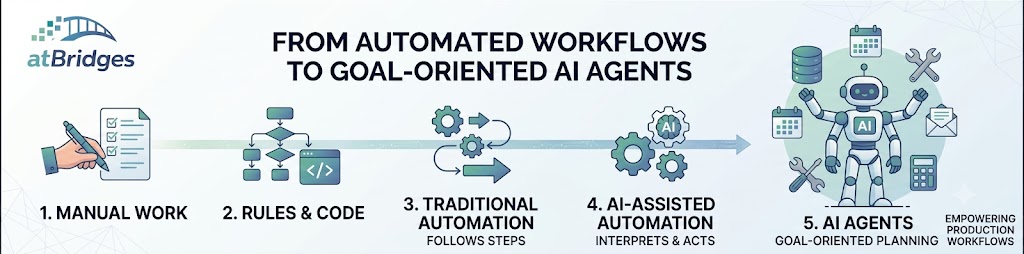
The evolution can be viewed as a progression:
Manual Work
↓
Rules
↓
Automation
↓
AI-Assisted Automation
↓
AI Agents
↓
Multi-Agent Systems
Traditional automation asks:
"What steps should I execute?"
AI agent systems increasingly ask:
"What outcome am I trying to achieve, and what actions should I take to get there?"
That shift from step execution to goal-oriented planning is one of the defining changes in modern AI applications.
The Future: Intelligent Orchestration
The most effective enterprise AI systems will likely not eliminate automation.
Instead, they will sit above existing systems and orchestrate them intelligently.
An AI agent can become the layer that connects:
- APIs
- CRMs
- Databases
- Communication systems
- Knowledge bases
- Business workflows
- Internal applications
- Automation platforms
The agent determines what needs to happen.
Existing software determines how the action is executed safely and reliably.
This creates a powerful architecture:
AI for reasoning + automation for execution + humans for oversight.
Conclusion
Automation and AI agents solve different problems. Automation is excellent at executing known processes consistently. AI agents are valuable when systems need to understand goals, make decisions, plan actions, and adapt to changing situations. The real opportunity isn't choosing one over the other. It is knowing where each belongs. For predictable tasks, use automation. For dynamic tasks requiring reasoning and planning, use agents.
And for complex production systems, combine both. The next generation of business software won't simply automate more workflows. It will increasingly understand the objective, create a plan, use the available tools, execute the work, evaluate the results, and involve humans when necessary.
The shift is from "automate the process" to "delegate the outcome."