Automation vs. Traditional Work vs. AI + Automation: The Future of Business Efficiency
Every business wants the same three things:
- - Get more work done
- - Reduce costs
- - Improve customer experience
The question isn't whether technology should be adopted—it's which technology provides the biggest advantage.
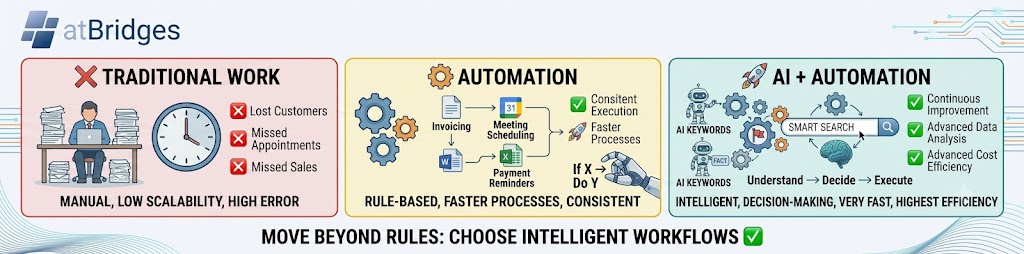
For years, businesses relied on manual processes. Then automation transformed repetitive work. Today, Artificial Intelligence (AI) is taking automation to the next level.
Let's understand the difference.
Stage 1: Traditional Work (Without Automation)
Traditional operations depend almost entirely on people.
Employees manually:
- Enter data
- Reply to emails
- Update spreadsheets
- Generate reports
- Follow up with customers
- Schedule appointments
- Create documents
- Search information
Every task requires human effort.
Example
Imagine receiving 500 customer inquiries daily.
Someone must:
- Read every email
- Understand the request
- Search for information
- Write a reply
- Update CRM
- Assign follow-up tasks
The process works—but it's slow and expensive.
Challenges
- Human errors
- Slow turnaround
- High operational costs
- Limited scalability
- Employees spend time on repetitive work
- Difficult to operate 24/7
Stage 2: Automation
Automation removes repetitive manual work.
Instead of people performing every step, software follows predefined rules.
Examples include:
- Automatically sending invoices
- Scheduling meetings
- Email workflows
- CRM updates
- Payment reminders
- File organization
- Form submissions
- Workflow approvals
Automation follows:
If this happens → Do that
Example
When a customer fills out a contact form:
- Create CRM record
- Send welcome email
- Notify sales
- Schedule follow-up reminder
Everything happens automatically.
Benefits
- Faster processes
- Fewer mistakes
- Lower costs
- Consistent execution
- Better productivity
Limitation
Automation does not think.
It only executes predefined rules.
If something unexpected happens, human intervention is still required.
Stage 3: AI + Automation
This is where modern businesses gain a competitive advantage.
AI doesn't just execute workflows.
It can:
- Understand language
- Analyze documents
- Make decisions
- Classify requests
- Generate content
- Summarize information
- Extract insights
- Recommend actions
Automation then executes those decisions.
Instead of:
If X happens → Do Y
The workflow becomes:
Understand → Decide → Execute
Example: Customer Support
Without Automation
Customer sends an email.
Employee:
- Reads it
- Finds information
- Writes response
- Updates CRM
Time:
15–20 minutes
With Automation
Customer submits a ticket.
Workflow:
- Creates ticket
- Assigns department
- Sends acknowledgment
A human still resolves the issue.
Time:
5–10 minutes
With AI + Automation
Customer sends an email.
AI:
- Understands the request
- Detects customer intent
- Finds relevant knowledge
- Drafts the response
- Updates CRM
- Creates follow-up tasks
- Escalates only complex cases
Human only reviews exceptions.
Time:
30–60 seconds
Real Business Examples
Sales
Traditional
Sales representatives manually research prospects.
Automation
Lead forms automatically populate the CRM.
AI + Automation
AI:
- Identifies high-value prospects
- Enriches lead data
- Drafts personalized outreach
- Schedules follow-ups
- Scores leads automatically
HR Recruitment
Traditional
Recruiters review every resume.
Automation
Applications are automatically stored.
AI + Automation
AI:
- Screens resumes
- Matches skills
- Ranks candidates
- Generates interview summaries
- Schedules interviews
Finance
Traditional
Accountants manually process invoices.
Automation
Invoices move through approval workflows.
AI + Automation
AI:
- Reads invoices
- Detects fraud
- Matches purchase orders
- Flags anomalies
- Predicts cash flow
Marketing
Traditional
Teams manually create campaigns.
Automation
Campaigns are scheduled automatically.
AI + Automation
AI:
- Generates content
- Personalizes emails
- Creates advertisements
- Segments audiences
- Optimizes campaign performance
Comparison Table
| Feature | Traditional | Automation | AI + Automation |
|---|---|---|---|
| Human involvement | Very High | Medium | Low |
| Decision making | Human | Rule-based | Intelligent |
| Speed | Slow | Fast | Very Fast |
| Scalability | Limited | High | Very High |
| Error rate | Higher | Low | Lowest |
| Learning capability | None | None | Continuous improvement |
| Content generation | Manual | No | Yes |
| Data analysis | Manual | Basic | Advanced |
| Customer support | Human | Workflow only | AI-powered |
| Cost efficiency | Low | Good | Excellent |
Why Businesses Are Moving Toward AI + Automation
Companies no longer want software that simply follows instructions.
They want systems that can:
- Understand requests
- Analyze data
- Make recommendations
- Execute workflows
- Learn from interactions
- Improve over time
This shift allows employees to focus on strategy, creativity, and customer relationships while AI handles repetitive and data-intensive tasks.
The Ideal Workflow
The most effective modern workflow combines human expertise with AI and automation:
- AI understands the request.
- AI decides the best course of action.
- Automation carries out the necessary tasks across connected systems.
- Humans step in only for approvals, exceptions, or complex decisions.
This approach delivers the speed of automation, the intelligence of AI, and the judgment of people where it matters most.
Final Thoughts
Traditional manual processes are reliable but difficult to scale. Automation significantly improves efficiency by handling repetitive tasks, yet it remains limited to predefined rules. AI-powered automation goes a step further by enabling systems to understand context, make informed decisions, and trigger intelligent workflows.
For businesses aiming to improve productivity, reduce costs, and deliver better customer experiences, the combination of AI + Automation is becoming the new standard. Organizations that embrace this shift can respond faster, operate more efficiently, and free their teams to focus on high-value work rather than routine tasks.
As AI capabilities continue to evolve, the future of business will not be about replacing people—it will be about empowering them with intelligent automation.