How to Build an AI-Powered Lead Generation System for Your Business
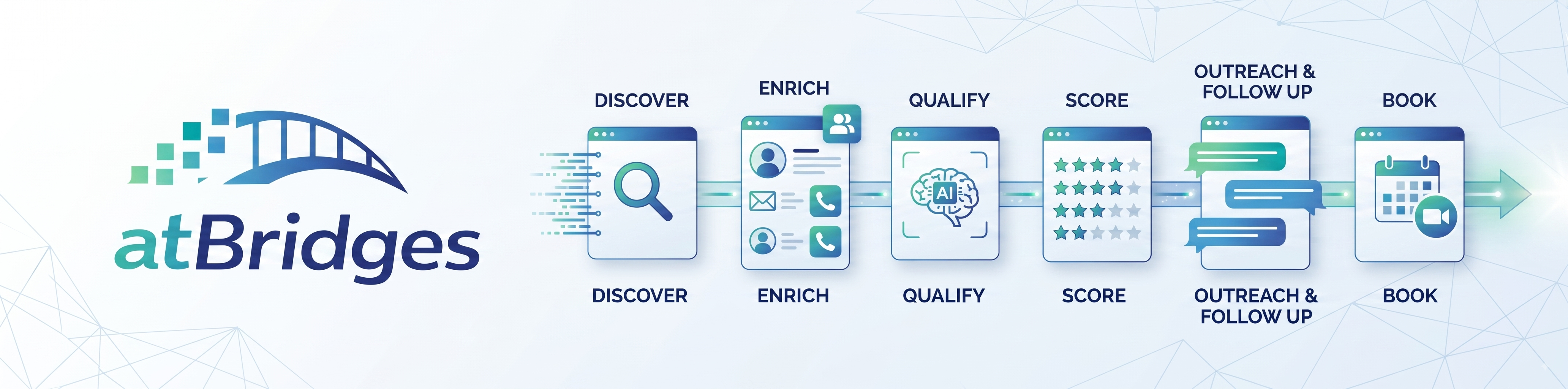
Generating leads is no longer just about collecting contact information. Modern sales teams need to find the right prospects, understand their needs, prioritize them, and engage them at the right time.
An AI-powered lead generation system can automate this entire process—from discovering prospects to booking meetings.
1. Discover the Right Prospects
The first step is finding businesses and decision-makers that match your Ideal Customer Profile (ICP).
Prospects can be discovered from sources such as LinkedIn, Google Maps, business directories, and company websites.
For example, a company selling healthcare software can search for healthcare businesses in a specific location and identify relevant decision-makers.
The goal isn't to collect thousands of random contacts. It's to find businesses that are likely to need your product.
2. Enrich Lead Information
Once prospects are discovered, the system can enrich their profiles with useful information such as:
- Contact name and job title
- Company and industry
- Email address
- Phone number
- Website
- LinkedIn profile
- Company details
This transforms a basic prospect into a complete lead profile that can be used for qualification and personalized outreach.
3. Qualify Leads With AI
This is where AI adds real intelligence to the process.Instead of simply checking whether a company matches an industry, AI can analyze the prospect's business and compare it with your product knowledge and documentation.
It can identify:
- Potential business needs
- Product fit
- Relevant use cases
- Buying signals
- Possible pain points
The AI can then generate an AI insight explaining why the prospect may be a good opportunity.
4. Score and Prioritize Leads
Every lead doesn't deserve the same amount of attention.
- AI can assign a score based on factors such as ICP fit + business need + product fit + buying signals
- High-scoring leads can be prioritized for immediate outreach, while lower-scoring leads can be placed into nurture campaigns.
This allows sales teams to focus on the highest-potential opportunities first.
5. Personalize Outreach
Once a lead is qualified, AI can generate personalized outreach based on the prospect's company, role, and identified needs. Instead of sending the same message to everyone, each prospect receives a message relevant to their business. Outreach can be coordinated across supported channels such as email, voice, SMS, and other communication channels.
6. Automate Follow-Ups
Many potential opportunities are lost simply because nobody follows up. AI can track responses and engagement and automatically determine when another follow-up is appropriate.If a prospect replies, the system can analyze the response and recommend the next action. If the prospect shows interest, they can move directly toward a meeting.
7. Book the Meeting
The final step is turning interest into a conversation. Once a prospect is qualified and interested, AI can help schedule the meeting, send confirmation, and keep the lead information updated.
The complete workflow becomes:
Discover → Enrich → Qualify → Score → Outreach → Follow Up → Book
Build a Smarter Lead Generation Engine
AI-powered lead generation isn't simply about finding more contacts. It's about finding better prospects and knowing what to do with them.With the right workflow, AI can connect prospect discovery, enrichment, product-aware qualification, lead scoring, personalized outreach, follow-ups, and appointment booking into one continuous sales process.
Platforms like AtBridges are designed to help businesses automate this journey and turn lead generation into a more intelligent, scalable sales engine.